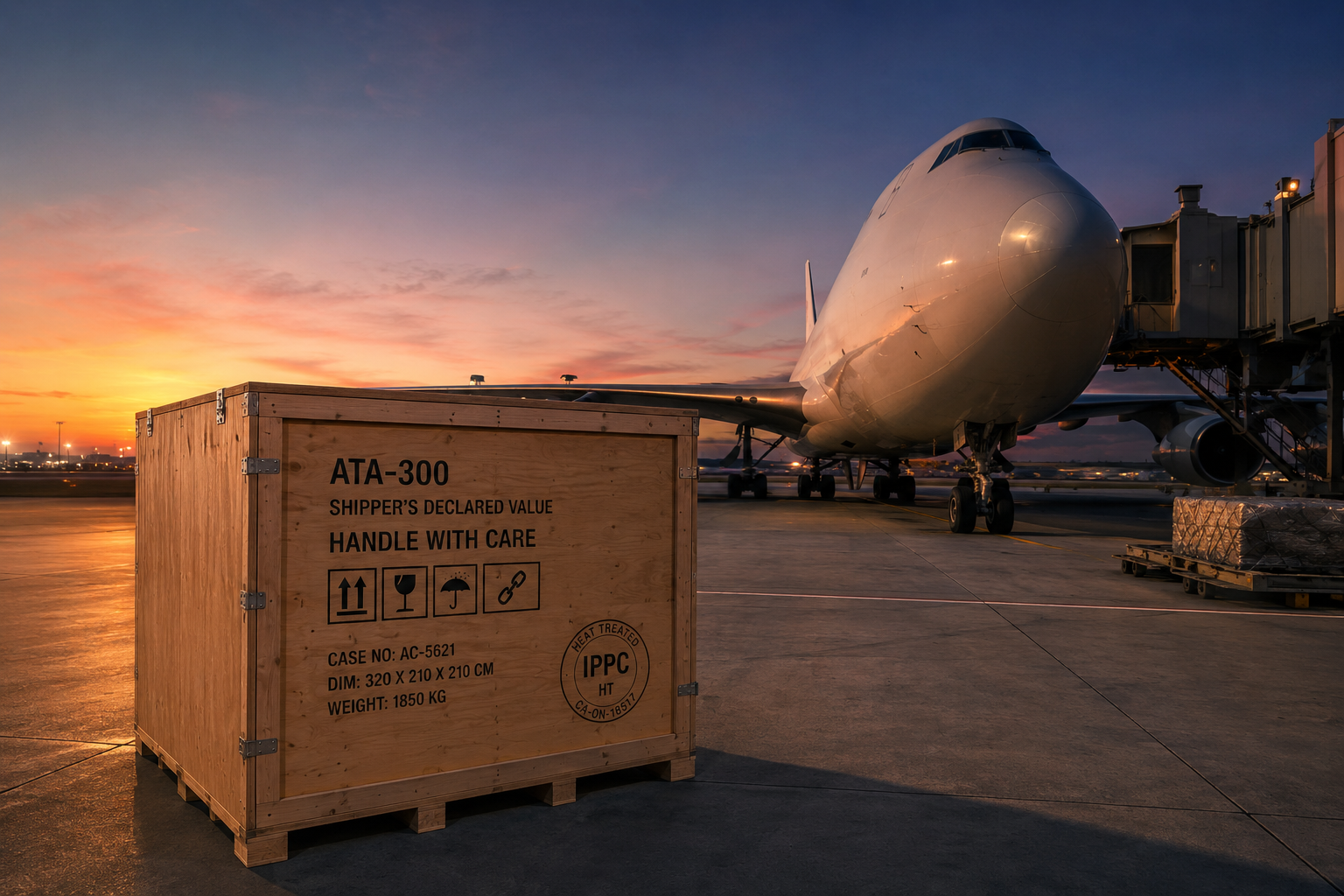
When an aircraft component leaves Canada for an international destination, two separate packaging standards apply at the same time. ATA-300 governs how the part is packaged for protection during shipping. ISPM-15 governs the wood used to build that package. One is an aviation industry standard. The other is international trade law enforced at every border crossing in the world.
Most aviation parts shippers know one or the other. Fewer realize both apply to the same crate simultaneously, and that failing either standard can ground a shipment at the port of entry.
Most aviation parts shippers know one or the other. Fewer realize both apply to the same crate simultaneously, and that failing either standard can ground a shipment at the port of entry.
What ATA-300 Requires
ATA-300 is the aerospace industry's packaging specification for aircraft spare parts. It defines how components must be protected during shipping to prevent damage to precision-machined surfaces, sensitive electronics, and structural assemblies.
Under ATA-300, packaging falls into two categories:
Category I covers reusable containers: engineered cases built to spec dimensions and used repeatedly across multiple shipments. Common for line-replaceable units and avionics that move regularly between facilities.
Category II covers custom one-time-use packaging: a purpose-built wooden crate engineered to the specific dimensions, weight, and fragility requirements of the part being shipped. Used for engines, large structural components, landing gear, and non-standard assemblies.
For most aircraft components shipped from Canadian MRO facilities and parts distributors, Category II applies. The crate is built to the part, not the other way around.
For more on ATA-300 crating for aircraft components, see our aircraft crating services page.
Under ATA-300, packaging falls into two categories:
Category I covers reusable containers: engineered cases built to spec dimensions and used repeatedly across multiple shipments. Common for line-replaceable units and avionics that move regularly between facilities.
Category II covers custom one-time-use packaging: a purpose-built wooden crate engineered to the specific dimensions, weight, and fragility requirements of the part being shipped. Used for engines, large structural components, landing gear, and non-standard assemblies.
For most aircraft components shipped from Canadian MRO facilities and parts distributors, Category II applies. The crate is built to the part, not the other way around.
For more on ATA-300 crating for aircraft components, see our aircraft crating services page.
What ISPM-15 Requires
ISPM-15 is the International Standards for Phytosanitary Measures No. 15, adopted by over 180 countries. It requires that all wood packaging entering international borders be heat-treated to a minimum core temperature of 56 degrees Celsius and stamped with the official IPPC certification mark.
The standard exists to prevent the spread of invasive wood pests across borders. It applies to every piece of wood in the shipment: the crate panels, the base skid, and any internal wood blocking or dunnage.
Customs authorities in the US, EU, Australia, Japan, and most other countries inspect incoming wood packaging. A crate without the IPPC stamp faces fumigation at the importer's expense, return to origin, or destruction of the packaging at the port.
For a full breakdown of ISPM-15 requirements by destination country, see our export crating services page.
The standard exists to prevent the spread of invasive wood pests across borders. It applies to every piece of wood in the shipment: the crate panels, the base skid, and any internal wood blocking or dunnage.
Customs authorities in the US, EU, Australia, Japan, and most other countries inspect incoming wood packaging. A crate without the IPPC stamp faces fumigation at the importer's expense, return to origin, or destruction of the packaging at the port.
For a full breakdown of ISPM-15 requirements by destination country, see our export crating services page.
When Both Standards Apply to the Same Crate
If you are shipping an aircraft component internationally in a custom wooden crate, ATA-300 and ISPM-15 apply to the same package at the same time:
This is where the gap happens. A shipper requests an ATA-300 Category II crate. The crating company builds it correctly to spec. But if the lumber is standard construction grade rather than ISPM-15 certified heat-treated lumber, the crate will be flagged at the destination border.
The crate can be ATA-300 compliant and ISPM-15 non-compliant at the same time. Both must be right, and both need to be confirmed with your crating company before the build.
- The crate structure must meet ATA-300 Category II requirements: engineering, protection, markings, and documentation
- The lumber used to build that crate must be ISPM-15 certified: heat-treated, IPPC stamped, and accompanied by certification documentation from the crating company
This is where the gap happens. A shipper requests an ATA-300 Category II crate. The crating company builds it correctly to spec. But if the lumber is standard construction grade rather than ISPM-15 certified heat-treated lumber, the crate will be flagged at the destination border.
The crate can be ATA-300 compliant and ISPM-15 non-compliant at the same time. Both must be right, and both need to be confirmed with your crating company before the build.
AOG Shipments Are Not Exempt
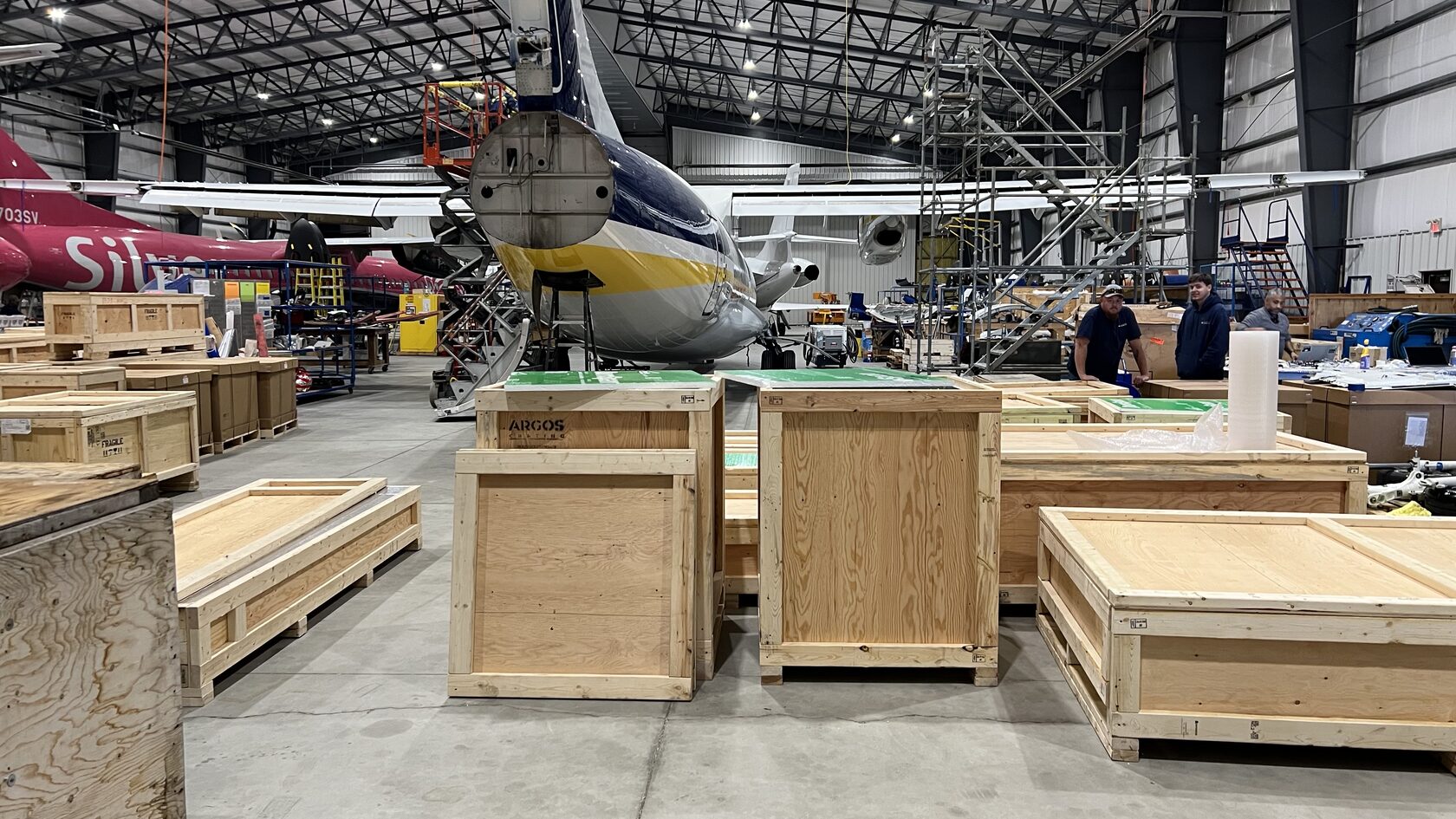
A common misconception on urgent shipments: AOG (Aircraft on Ground) designation does not exempt a shipment from phytosanitary inspection.
A non-certified wooden crate on an AOG shipment gets flagged the same as any other. US border inspectors do not clear wood packaging based on shipment urgency. If the IPPC stamps are missing or the lumber is not certified, the shipment gets held while the situation is resolved.
For Argos, same-day AOG crating is standard. ISPM-15 certified lumber is also standard. There is no trade-off between speed and compliance.
A non-certified wooden crate on an AOG shipment gets flagged the same as any other. US border inspectors do not clear wood packaging based on shipment urgency. If the IPPC stamps are missing or the lumber is not certified, the shipment gets held while the situation is resolved.
For Argos, same-day AOG crating is standard. ISPM-15 certified lumber is also standard. There is no trade-off between speed and compliance.
What the Documentation Package Looks Like
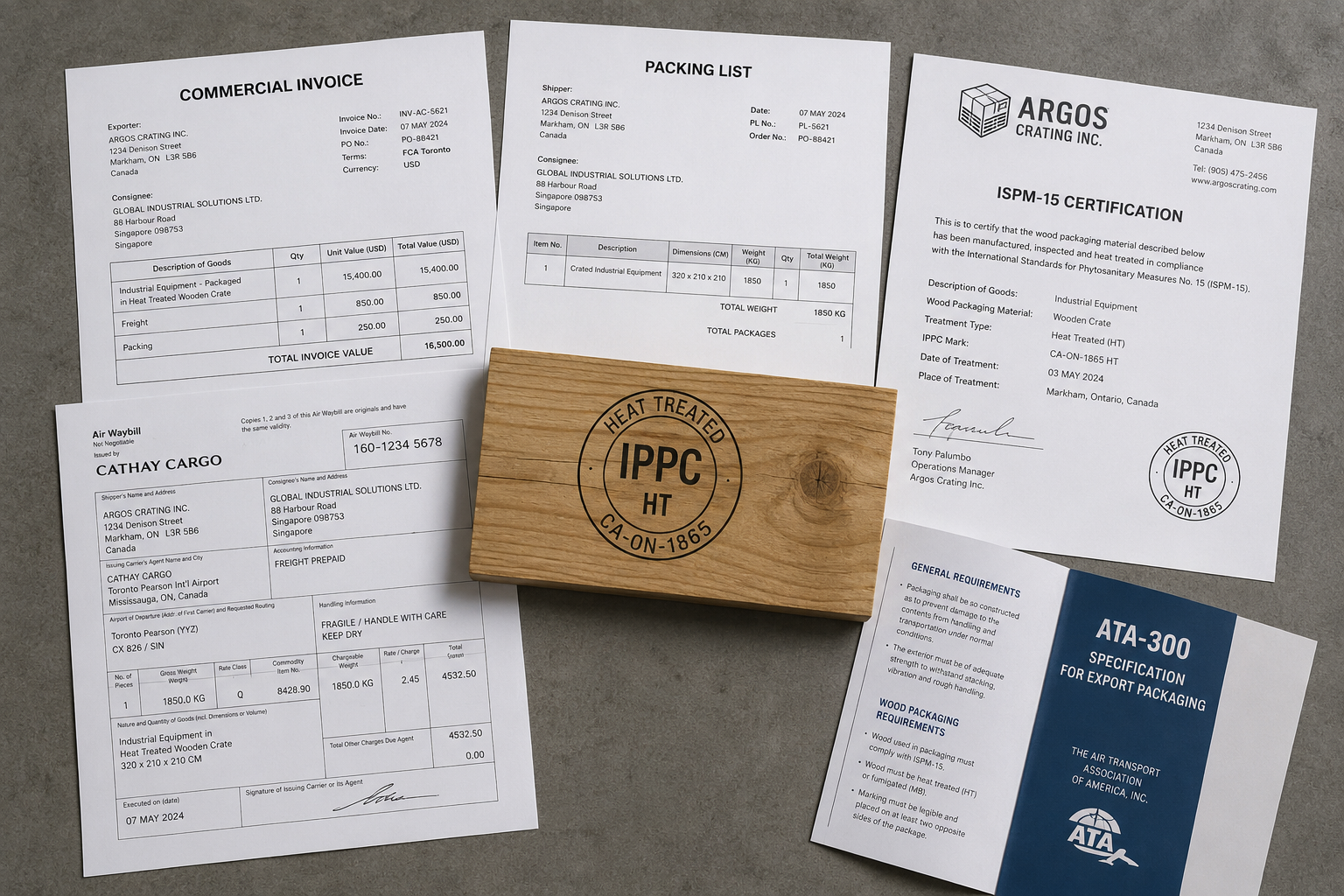
An internationally shipped aircraft component in an ATA-300 Category II crate should travel with the following:
From the crating company:
Shipping and customs documentation:
Your freight forwarder or customs broker will need the ISPM-15 certification letter from the crating company before the shipment is tendered to the carrier. Confirm this handoff timing when placing the crating order.
From the crating company:
- ISPM-15 certification letter confirming all lumber is heat-treated and certified
- Crate dimensions, gross weight, and net weight confirmation
- IPPC stamps visible on exterior crate panels
Shipping and customs documentation:
- Commercial invoice with HS code, declared value, and country of origin
- Airway bill or bill of lading
- Packing list referencing the crate dimensions and ISPM-15 compliance
- USMCA Certificate of Origin for US shipments qualifying for duty-free treatment
- Dangerous goods declaration if applicable (hydraulic fluid residue, batteries, compressed gases)
Your freight forwarder or customs broker will need the ISPM-15 certification letter from the crating company before the shipment is tendered to the carrier. Confirm this handoff timing when placing the crating order.
Questions to Ask Your Crating Company
Before placing the order:
A crating company that handles aerospace export regularly will answer all five without hesitation.
- Is your lumber ISPM-15 certified? (Not kiln-dried. Not construction grade. Specifically heat-treated to ISPM-15 spec with IPPC stamp.)
- Do you build ATA-300 Category II custom crates?
- Do you provide a signed ISPM-15 certification letter for customs?
- Can you coordinate documentation directly with our freight forwarder?
- What is your standard lead time, and do you offer same-day for AOG?
A crating company that handles aerospace export regularly will answer all five without hesitation.
Argos Crating Builds to Both Standards
We build ATA-300 Category II crates using ISPM-15 certified heat-treated lumber as standard. Every international shipment includes a certification letter for customs and full weight and dimension documentation for your freight forwarder. Located in Mississauga, minutes from Pearson Airport cargo terminals.
Get a quote for aircraft parts export crating →
We build ATA-300 Category II crates using ISPM-15 certified heat-treated lumber as standard. Every international shipment includes a certification letter for customs and full weight and dimension documentation for your freight forwarder. Located in Mississauga, minutes from Pearson Airport cargo terminals.
Get a quote for aircraft parts export crating →