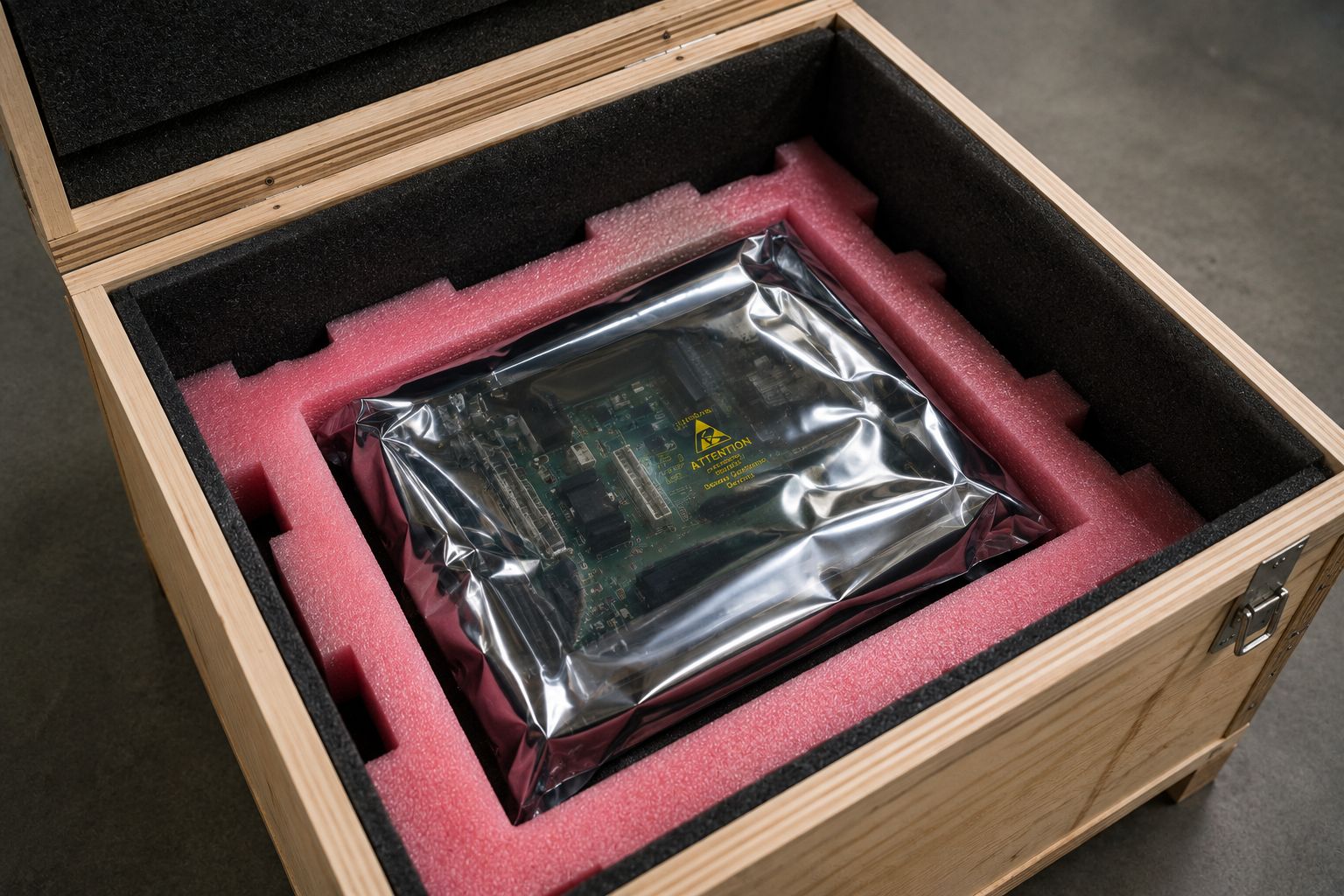
A circuit board can be destroyed by a static discharge of 10 to 100 volts. A human doesn't feel a static shock below roughly 3,000 volts. That gap is the problem. Electronics are routinely damaged by electrostatic discharge during shipping and handling, with no visible evidence that anything went wrong. The part arrives looking intact. It fails in operation.
For anyone shipping circuit boards, avionics, medical device electronics, industrial controls, or semiconductor components, ESD protection during crating and transit is not optional. This article covers how it works, what proper ESD-safe packaging includes, and what to look for when selecting a crating company for sensitive electronics.
Argos Crating provides ESD-safe electronics crating for manufacturers and shippers across Ontario.
What Is ESD and Why Does Transit Create Risk
Electrostatic discharge (ESD) is the sudden flow of electricity between two objects with different electrical charges. It happens when charged surfaces come into contact or when an object is brought close enough to a charged field that electrons jump.
Shipping and crating create ESD risk in several specific ways:
Friction. Standard foam, plastic wrap, and cardboard all generate static charge when rubbed against surfaces. A circuit board sliding inside standard packaging during transit generates charge with every movement.
Dry air. Static builds up more easily in low-humidity environments. Air cargo holds and temperature-controlled freight environments often run at low humidity, accelerating charge accumulation.
Vibration. Continuous low-level vibration during truck or air transport creates repeated micro-contacts between the component and its packaging, generating and accumulating charge over hours.
Handling. Picking up an unprotected component, placing it on a surface, or moving it through a loading environment exposes it to the charges carried by people, equipment, and materials nearby.
The damage from ESD is frequently latent — the component is weakened but not immediately non-functional. It passes incoming inspection and fails weeks or months later in the field.
What ESD-Safe Packaging Actually Means
There are four material categories used in ESD-safe packaging, and they serve different functions:
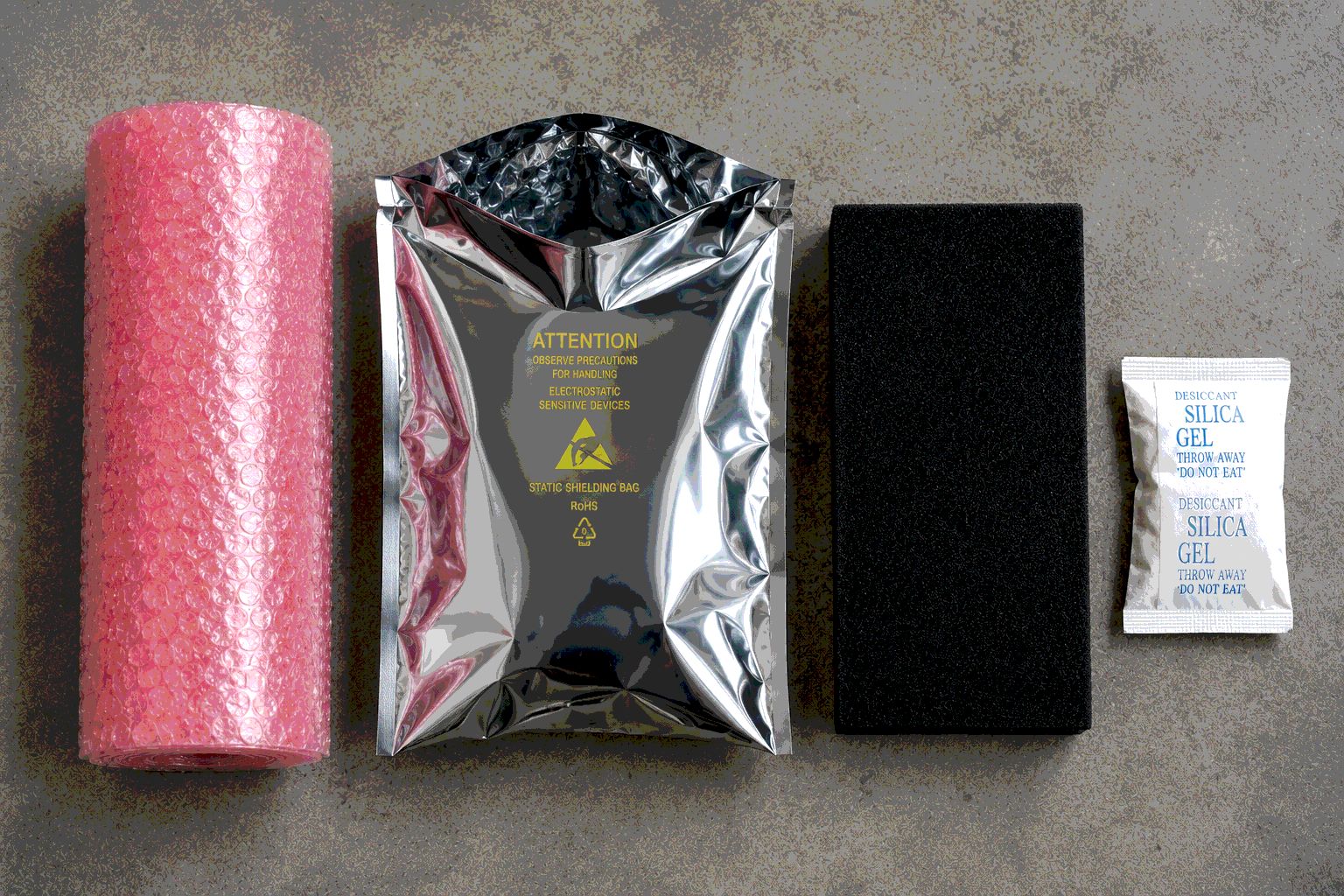
Anti-static materials prevent static charge from building up on the packaging material itself. Anti-static foam (typically pink in colour) and anti-static bubble wrap are common examples. They cushion the component without generating charge through friction. This is the most basic level of protection.
Dissipative materials allow slow, controlled discharge rather than sudden release. Surface resistivity in the range of 10 to the 4th through 10 to the 11th ohms. Used for foam inserts, trays, and liners where contact with the component is direct and continuous.
Conductive materials discharge rapidly. Black conductive foam is the most common. Used for very high-sensitivity components where even slow discharge is a concern.
ESD shielding bags are the outer layer. A metalized shielding bag creates a Faraday cage around the component, blocking external electrostatic fields entirely. These are the silver or black metallic bags used in electronics manufacturing and repair environments. For transit, a component should be inside a shielding bag before it goes into any outer packaging or crate.
The common mistake: using anti-static foam without an ESD shielding bag. Anti-static foam prevents the foam from generating charge but provides no protection from external fields. Both are needed.
What Goes Inside an ESD-Safe Crate
A properly built ESD-safe wooden crate has three functional layers working together:
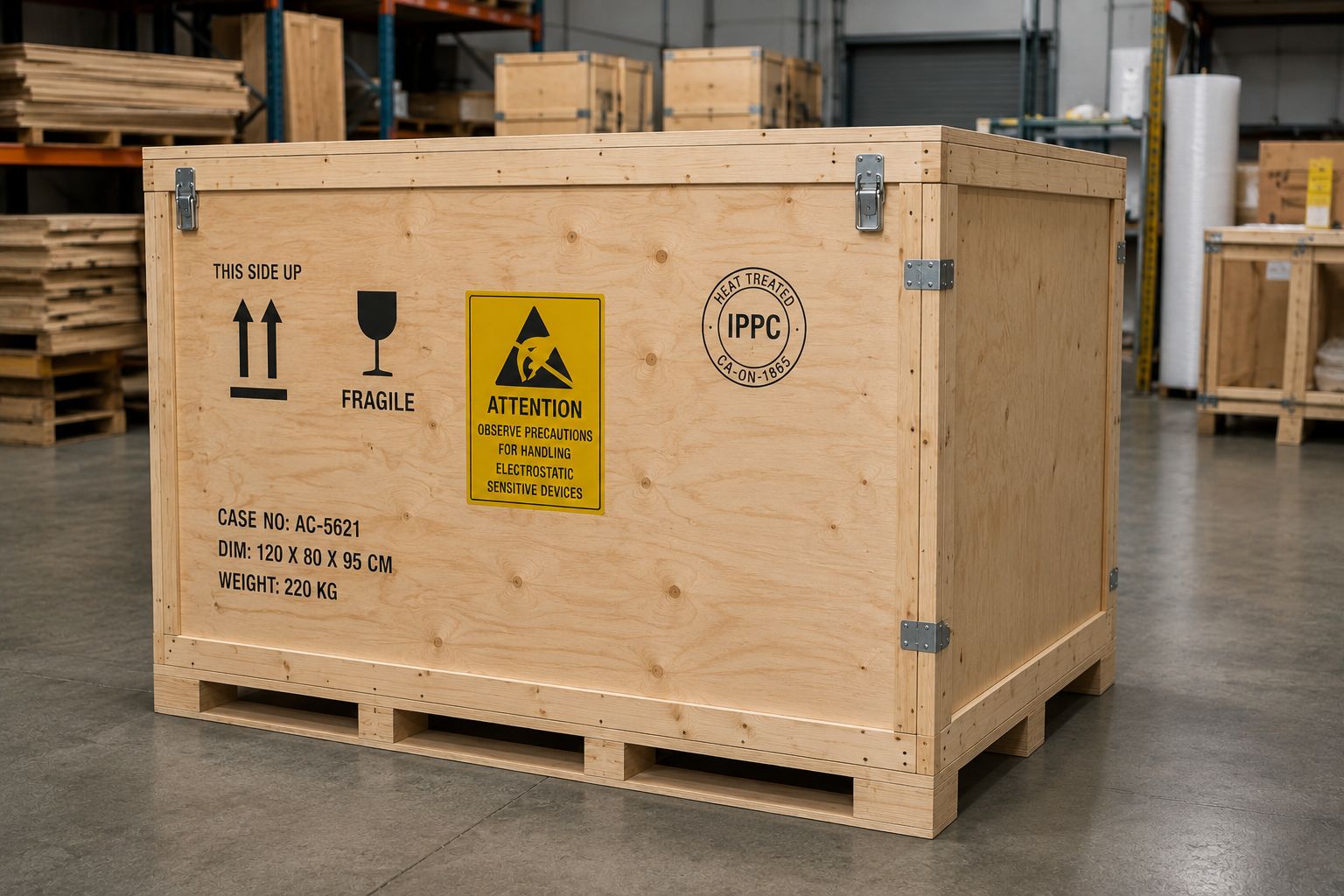
Outer structure. The wooden crate provides mechanical protection: impact resistance, compression strength, and the ability to be stacked and moved by forklift without crushing the contents. For export shipments, the lumber is ISPM-15 certified. The crate is engineered to the specific dimensions and weight of the cargo.
Inner lining. The interior walls of the crate are lined with ESD-dissipative foam or conductive material to prevent charge buildup from the crate structure itself contacting or influencing the component.
Component packaging. The component arrives pre-packaged in a shielding bag, placed inside a form-fitted anti-static foam insert that holds it secure against vibration. The insert prevents movement during transit without generating static through friction.
For high-sensitivity components such as avionics, FMCs, and medical device circuit boards, desiccant packs are also included inside the sealed barrier to control humidity at the component level throughout the shipment.
Industries and Components That Require ESD-Safe Crating
Avionics and aerospace components. Flight management computers, navigation units, radar systems, and electronic LRUs (line-replaceable units) require ESD protection as standard. ATA-300 Category II wooden crates with ESD-safe interiors are the correct packaging for these components during shipping and storage. Damaged avionics from improper packaging create both safety and liability issues in aerospace operations.
Medical devices and diagnostic equipment. Electronic medical instruments, imaging components, infusion pump control boards, and diagnostic equipment all contain ESD-sensitive electronics. Many medical devices also have regulatory requirements around packaging documentation.
Industrial control systems. PLC units, servo drives, VFDs (variable frequency drives), and control boards for manufacturing equipment are expensive, long-lead components where ESD damage causes significant downtime.
Semiconductor and PCB shipments. Bare circuit boards and semiconductor wafers are among the most ESD-sensitive items shipped commercially. These move in volume through Ontario's technology and electronics manufacturing corridor.
Telecommunications equipment. Switching equipment, base station electronics, and network hardware contain components with ESD sensitivity ratings in the tens of volts range.
Questions to Ask Your Crating Company
Before placing an order for crating of ESD-sensitive equipment:
A crating company that handles electronics regularly will have clear answers. One that handles general cargo only will likely not stock ESD-rated materials.
- Do you use ESD shielding bags as part of the packaging, or anti-static foam only?
- What is the surface resistivity rating of the foam inserts you use?
- Do you line the interior of the crate with ESD-dissipative material?
- Can you build a form-fitted foam insert to prevent movement during transit?
- Do you include desiccant packs for humidity control on request?
- For avionics and aerospace components: do you build ATA-300 Category II compliant crates?
A crating company that handles electronics regularly will have clear answers. One that handles general cargo only will likely not stock ESD-rated materials.
ESD-Safe Crating for Electronics and Avionics
Argos Crating builds ESD-safe wooden crates for electronics, avionics, medical devices, and industrial control systems. Anti-static foam inserts, shielding bag integration, and ESD-dissipative interior lining are available as standard options. Located in Mississauga, serving manufacturers and shippers across the GTA and Southern Ontario.
Get a quote for electronics crating →
Get a quote for electronics crating →
Frequently Asked Questions - ESD-Safe Crating
Q: What is the difference between anti-static and ESD shielding packaging?
Anti-static materials prevent static charge from building up on the packaging itself. ESD shielding (the silver metallic bag) creates a Faraday cage that blocks external electrostatic fields from reaching the component inside. For transit, you need both: anti-static foam cushioning plus a shielding bag as the outer layer around the component.
Q: Can a standard wooden crate damage electronics during shipping?
Not directly — wood itself is not a significant ESD risk. The problem is what goes inside. Standard foam and plastic liners generate static charge through friction during transit. Without ESD-rated interior materials and shielding bags, the component inside is exposed to charge buildup throughout the shipment.
Q: Do all electronic components need ESD-safe packaging?
Components with ESD sensitivity ratings below 1,000 volts require shielding bags and anti-static cushioning as a minimum. This includes most integrated circuits, circuit boards, semiconductors, and avionics. Consumer electronics and components with sensitivity above 16,000 volts are lower risk but still benefit from anti-static materials. When in doubt, the cost of ESD-safe packaging is small compared to the cost of replacing a damaged component.
Q: What is a Faraday cage and why does it matter for electronics shipping?
A Faraday cage is an enclosure made of conductive material that blocks external electric fields. ESD shielding bags work on this principle: the metallic outer layer intercepts electrostatic fields before they reach the component inside. This is why the bag must be fully sealed — an open shielding bag provides no protection.
Q: Can you build ESD-safe crating for avionics and aerospace components?
Yes. We build ATA-300 Category II wooden crates with ESD-dissipative interior lining, anti-static foam inserts, and shielding bag integration for avionics, FMCs, electronic LRUs, and aerospace components. For international shipments, ISPM-15 certified lumber is used as standard.
Q: How do I know if a crating company is using proper ESD materials?
Ask for the surface resistivity rating of the foam they use. Anti-static foam should be in the 10⁹ to 10¹² ohm range; dissipative foam in the 10⁴ to 10¹¹ range. Ask whether shielding bags are included as standard or on request. A company that handles electronics regularly will answer without hesitation. A general crating company may not stock ESD-rated materials at all.